A caregiver called me the other day and said that someone might be contacting me about a mediation problem they were facing. She said that the person who was contacting me thought that it might be useful to speak with me because of my legal training. The interesting thing was that this wasn't a legal problem at all.
I'm grateful for my formal education but honestly, I've learnt much more during my time with CWS. The bottom line is - it doesn't matter what your educational level is or what you were trained in. One of the best mediators I know is a woman who doesn't speak much English and yet manages to almost always solve the problems.
There's no special 'trick' to being a good mediator or even a caregiver. Being a doctor, or a lawyer, or an accountant doesn't automatically make you better at it. Certainly you can go for classes and courses for mediation at least, but the most important thing is experience.
I think a lot of us are hung up on titles or degrees. It's only natural - but we're much more than our formal education. Mark Twain, who himself left school early, famously said, "I never let my schooling interfere with my education".
Don't think that you are not 'qualified ' to be a caregiver, or a mediator because you don't have the right 'training'. All you need is a desire to keep learning, a calm temperament, and a bit of common sense. There are tons of resources - more so now than ever before. There is a vast array of information on the Net alone. There are other caregivers or mediators who can give advice whether online, or in person, or over the phone.
You'll be surprised how much you learn just by observation. Much of it cannot be taught - though an experienced caregiver may be able to point it out to you.
Finally, remember that everyone has their own set of skills. Some people will make excellent caregivers, others, fantastic mediators. Still others may be fantastic fosters. Find out what you enjoy and what you're good at and that's where you'll best be able to contribute, no matter what your 'training' might have been in.
Friday, July 31, 2009


Thursday, July 30, 2009
Alley Cat Allies
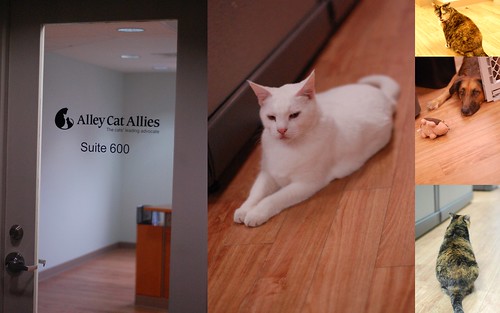
I visited with the nice people from Alley Cat Allies today. However you're getting photos of the cats and dogs because admit, it - you're rather see the animals :)
Also, people can be shy - but what can a cat do when it doesn't want it's photo taken? Jazzy on the lower right hand corner demonstrates the correct etiquette when she's had enough photo taking for one day.
Wednesday, July 29, 2009
South-pawed kitties?
Interesting article though it was a small study group - anyone want to try it on their cats? :)
Tuesday, July 28, 2009
Territory
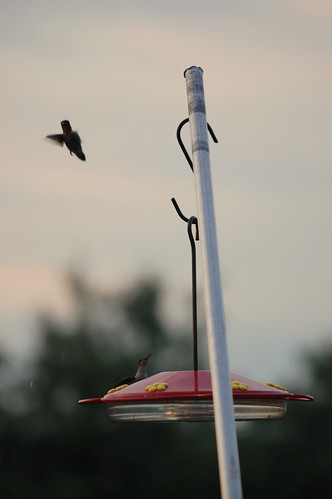
You know the old untruth that people shouldn't feed cats because more and more cats will come into an area when there is food? The more I watch different animals, the more I see how untrue it is, not just for cats, but for other animals too.
We all know that cats enter an area because of territory, not because of food. However, this isn't just limited to cats. If anything else, it's almost as if the animals don't want others near 'their' territory and food. In this photo, the hummingbird below is watching the hummingbird above as the latter tries to move closer to the food bowl. It doesn't matter that there are several food ports. It doesn't matter that there is plenty of food for both birds (and others besides). The hummingbird just does NOT want the other bird in its territory, or near its food.
I've seen hummingbirds that will just sit there and warn others away from the feeding station. I've heard someone say that her hummingbird would rather go hungry then let anyone else close.
This is the case for squirrels, raccoons and other birds even when there is ample food. I hang a finch sock outside and the finches have their own 'spots' even though there is plenty of food. If a finch attempts to sit on another 'spot', he or she is driven away.
The only time this doesn't seem to apply so much? Mating season.
So sterilised cats don't have that issue - and they get even more territorial about their area. Food really isn't the issue.
Monday, July 27, 2009
Observatory Cats
In New Hampshire, there is an observatory that studies the weather. It is apparently extremely cold most of the year. What is interesting is that they have always had observatory cats. The last active cat, who 'retired' two years ago, just passed away at age 19. Here are some photos of how cold it can get.
Thursday, July 23, 2009
The vaccuum effect and natural attrition
Today's post is about two phrases we bandy around a lot :- the 'vacuum effect' and 'natural attrition'.
Here's a definition of the vacuum effect from Alley Cat Allies. Here's a definition of attrition. Now that we have our definitions out of the way, we can talk a bit about what they really mean to us in terms of TNRM :)
Some people deny that this happens - and most of the time it's because they've never dealt with a colony being removed.
However, most people who DO work with cats, or who have had issues with the cats will have noticed that the vacuum effect is very real. This includes a condominium I know that used to spend a few thousand a year getting 'rid' of the cats or town councils that asked why there are new cats coming in when the existing ones were removed and killed. This also includes a caregiver I know who removed the cats from the area thinking it wasn't safe on the streets. When she went by the next day, there were four new cats waiting.
We see how nature abhors a vacuum every day in nature. We see it when water floods in to fill an empty space, or when air does. I'm sure one day we may even understand WHY it happens, but we can already see its effects. We may not all understand how gravity works exactly (or maybe that's just me:)), but we don't deny it exists.
Many people may not have much exposure to cats - and that's where caregivers like you guys come into play. That's also why it is so important that caregivers are accurately able to explain concepts to people who may not know much about cats.
I spoke recently with a caregiver who said that natural attrition would kill off all the cats in the area. It's natural (no pun intended) to be confused when so much literature tells us that natural attrition will kill off the cats. BUT, if you accept that the vacuum effect exists, then there is no way that natural attrition can kill off ALL the cats. Will natural attrition kill off cats? Yes, of course it will. Cats can't live forever after all. It may even, when coupled with sterilisation, bring the population down dramatically depending on the size of your colony. But to have NO cats in the area? Not if you accept the vacuum effect because logically new cats will move in when there is a vacuum.
At some point, the colony numbers after the cats have been sterilised, will drop to such a point that the territory CAN accommodate more cats - note I said, territory, NOT food. Even if you try and remove all newcomers, new cats are going to keep showing up. Some of you may remember the analogy I once gave. If you have a castle with four entrances, and you have five or six guards posted at each door, chances are you'll be able to defend the castle. If you have two guards, chances are that some intruders are going to sneak in. It's the same with the cats.
The vacuum effect does not respect your intentions, good or otherwise. The vacuum effect does not care whether you removed the cats to adopt them or relocate them. It does not care if the cats died a natural death or were killed in animal control somewhere.
Some of you may wonder why I'm splitting hairs about this, but it's very important that a person or organisation who agrees to a TNRM programme knows what to expect. Some expecting that all the cats will die out after they have lived out their natural lifespan and that there will be zero cats is going to be in for a big shock. They might well think the programme is a failure.
Some complainants may also ask why not just remove all the cats NOW. If they are all taken away, then why wait for them to be sterilised and eventually die. In other words why wait for natural attrition to kick in, when we can have UNnatural attrition?
I know some people will say that complainants may not want to hear that the cats are always going to be there. I believe that if you're honest right up front, but say that a managed, sterilised, cared for colony will create less issues than an unmanaged, growing cat population, most people will see the sense in that. Yes, the colony may always be there - but it doesn't NEED to cause any problems. Removing the cats and killing them just means the same issues come back over, and over again. It may of course take more than one conversation to get someone to agree but don't give up. There's tons of resources online and it's a good idea to take the information with you - one good resource is ACA's website.
At the end of the day, your argument has to be logically consistent to you, before you can convince someone else.
Here's a definition of the vacuum effect from Alley Cat Allies. Here's a definition of attrition. Now that we have our definitions out of the way, we can talk a bit about what they really mean to us in terms of TNRM :)
Some people deny that this happens - and most of the time it's because they've never dealt with a colony being removed.
However, most people who DO work with cats, or who have had issues with the cats will have noticed that the vacuum effect is very real. This includes a condominium I know that used to spend a few thousand a year getting 'rid' of the cats or town councils that asked why there are new cats coming in when the existing ones were removed and killed. This also includes a caregiver I know who removed the cats from the area thinking it wasn't safe on the streets. When she went by the next day, there were four new cats waiting.
We see how nature abhors a vacuum every day in nature. We see it when water floods in to fill an empty space, or when air does. I'm sure one day we may even understand WHY it happens, but we can already see its effects. We may not all understand how gravity works exactly (or maybe that's just me:)), but we don't deny it exists.
Many people may not have much exposure to cats - and that's where caregivers like you guys come into play. That's also why it is so important that caregivers are accurately able to explain concepts to people who may not know much about cats.
I spoke recently with a caregiver who said that natural attrition would kill off all the cats in the area. It's natural (no pun intended) to be confused when so much literature tells us that natural attrition will kill off the cats. BUT, if you accept that the vacuum effect exists, then there is no way that natural attrition can kill off ALL the cats. Will natural attrition kill off cats? Yes, of course it will. Cats can't live forever after all. It may even, when coupled with sterilisation, bring the population down dramatically depending on the size of your colony. But to have NO cats in the area? Not if you accept the vacuum effect because logically new cats will move in when there is a vacuum.
At some point, the colony numbers after the cats have been sterilised, will drop to such a point that the territory CAN accommodate more cats - note I said, territory, NOT food. Even if you try and remove all newcomers, new cats are going to keep showing up. Some of you may remember the analogy I once gave. If you have a castle with four entrances, and you have five or six guards posted at each door, chances are you'll be able to defend the castle. If you have two guards, chances are that some intruders are going to sneak in. It's the same with the cats.
The vacuum effect does not respect your intentions, good or otherwise. The vacuum effect does not care whether you removed the cats to adopt them or relocate them. It does not care if the cats died a natural death or were killed in animal control somewhere.
Some of you may wonder why I'm splitting hairs about this, but it's very important that a person or organisation who agrees to a TNRM programme knows what to expect. Some expecting that all the cats will die out after they have lived out their natural lifespan and that there will be zero cats is going to be in for a big shock. They might well think the programme is a failure.
Some complainants may also ask why not just remove all the cats NOW. If they are all taken away, then why wait for them to be sterilised and eventually die. In other words why wait for natural attrition to kick in, when we can have UNnatural attrition?
I know some people will say that complainants may not want to hear that the cats are always going to be there. I believe that if you're honest right up front, but say that a managed, sterilised, cared for colony will create less issues than an unmanaged, growing cat population, most people will see the sense in that. Yes, the colony may always be there - but it doesn't NEED to cause any problems. Removing the cats and killing them just means the same issues come back over, and over again. It may of course take more than one conversation to get someone to agree but don't give up. There's tons of resources online and it's a good idea to take the information with you - one good resource is ACA's website.
At the end of the day, your argument has to be logically consistent to you, before you can convince someone else.
Wednesday, July 22, 2009
Stones in garden

I attended a meeting with the feeders, the people who were facing problems, and two other mediators this evening.
One of the mediators had gone down over the weekend and set stones down in the garden to prevent the cats from defecating there. Aminah - I remember you asked your town council to do this, and they eventually did, which also stopped the defecation problem there.
The good news is that there will be a 6 month trial period and if the situation is good, the programme can continue. We mentioned that it's a good idea to keep the lines of communication open during this period - and not have an accumulation of problems till later.
The bad news - unfortunately there does seem to still be quite a lot of distrust in the room. I do hope that the different groups will be able to start anew.
This is why it's sometimes useful to have mediators come in. They're not privy to all the bad blood that may have occurred in some situations, and can hopefully bring a more objective eye to the situation. Some caregivers are wonderful at caring for the cats, but may not be the best at mediating. This is why designated mediators can really be helpful. As we have discussed before, one of the main advantages is that mediators may be able to help out as well on a more flexible schedule - ie they obviously won't be called in every day - but they'll still perform a crucial role in a TNRM programme.
What was really helpful today was that one of the mediators drafted an agreement so that both sides knew what was expected from each side. It would be also good, and I am sure they'll be adding this in, to put in what the expected results will be in 6 months - or our dreaded Singaporean KPI :)
Subscribe to:
Posts (Atom)